Johnny Cash Back in the High Life Again
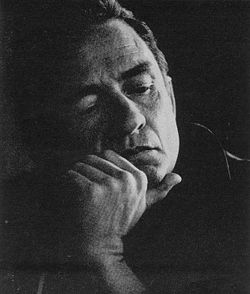
J. R. Cash (February 26, 1932 – September 12, 2003), better known as Johnny Cash, was an influential American country and rock and roll singer and songwriter. Cash was the husband of country vocalizer and songwriter June Carter Greenbacks.
Cash was known for his deep and distinctive voice, the boom-chick-a-boom or "freight train" audio of his Tennessee Iii bankroll band, and his night habiliment and demeanor, which earned him the nickname "The Man in Black." He started all his concerts with the simple introduction "How-do-you-do, I'grand Johnny Cash."
Much of Cash's music, particularly that of his later career, echoed themes of sorrow, moral tribulation, and redemption. His signature songs include "I Walk the Line," "Folsom Prison house Blues," "Ring of Burn down," and "The Human being in Black." He also recorded several humorous songs, such as "One Piece at a Time," "The One on the Right is on the Left," and "A Boy Named Sue"; bouncy numbers such as "Get Rhythm"; and various railroad train-related songs, such as "The Rock Isle Line."
Johnny Cash sold over l million albums in his nearly 50-year career and is mostly recognized as one of the most of import musicians and recording artists in the history of American popular music.
Early life
Johnny Cash was born J. R. Greenbacks in Kingsland, Arkansas, and raised in Dyess, Arkansas. By historic period five, he was working in the cotton fiber fields, singing forth with his family as they worked. The family farm was flooded on at least one occasion, which after inspired him to write the song "Five Feet Loftier and Rise" (Cash 1997). His older blood brother Jack died in a tragic on-the-chore accident, working a high school store table saw, in 1944 (Greenbacks 1997). His family's economic and personal struggles during the Depression shaped him every bit a person and inspired many of his songs, especially those virtually other people facing personal struggles.
Cash'southward early on memories were dominated by gospel music and radio. He began playing guitar and writing songs as a young boy and in high school sang on a local radio station. Decades later on, he would release an album of traditional gospel songs, chosen My Mother's Hymn Book. Irish music that he heard weekly on the Jack Benny radio plan, as performed past Dennis Day, influenced him greatly (Gross 2006).
He was reportedly given the name J. R. considering his parents could not agree on a name, only on initials. (Giving children such names was a relatively common practice at the time.) When he enlisted every bit a radio operator in the United States Air Force, the armed forces would not accept just initials every bit his name, so he adopted John R. Cash as his legal name. When he signed for Sun Records in 1955, he took "Johnny" Greenbacks as a stage proper noun. His friends and in-laws generally called him John, and his claret relatives oftentimes called him J. R.
Early career
After basic preparation at Lackland Air Forcefulness Base and technical training at Brooks Air Force Base, both in San Antonio, Cash was sent to a U.South. Air Force Security Service unit at Landsberg Air Base, Germany. There, he founded his first ring, the Landsberg Barbarians.
Subsequently his term of service ended, Cash married Vivian Liberto, whom he met while grooming at Brooks. In 1954, he moved to Memphis, Tennessee, where he sold appliances while studying to be a radio journalist. At nighttime, he played with guitarist Luther Perkins and bassist Marshall Grant (together known at first as the Tennessee Three). Greenbacks worked upwards the courage to visit the Sun Records studio, hoping to garner a recording contract. Later on auditioning for Sam Phillips, singing mainly gospel tunes, Phillips told him to "go home and sin, then come back with a song I can sell." Cash somewhen won over Phillips with new songs delivered in his early on corybantic style. His commencement recordings at Sun, "Hey Porter" and "Cry Cry Cry" were released in 1955, and met with reasonable success on the land music striking parade.
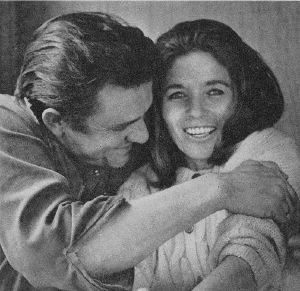
Johnny Greenbacks and his second wife, June Carter Cash
Greenbacks's side by side record, Folsom Prison Blues, fabricated the country top five, and "I Walk the Line" was mumber one on the land charts, making it into the popular charts' top twenty. Following "I Walk the Line" was Johnny Cash's "Home of the Dejection" recorded in July 1957. In 1957, Cash became the first Sun artist to release a long-playing album. Although he was Lord's day Tape's nigh consistent, acknowledged, and prolific artist at that fourth dimension, Cash felt constrained by his contract with the small characterization. Elvis Presley had already left Sun, and Phillips was focusing most of his attention and promotion on Jerry Lee Lewis. The post-obit year, Cash left the label to sign a lucrative offer with Columbia Records, where his single "Don't Take Your Guns to Town" would become one of his biggest hits.
Cash'southward first child, a daughter, Rosanne, was built-in in 1955. Although he would have three more daughters (Kathleen in 1956, Cindy in 1959, and Tara in 1961) with his first wife, they divorced in 1966, due to his constant touring. It was during ane of these tours that he met June Carter, whom he would subsequently marry in 1968.
Drug addiction
As his career was taking off in the early 1960s, Greenbacks began drinking heavily and became addicted to amphetamines and barbiturates. For a brief time, Greenbacks shared an flat in Nashville with Waylon Jennings, who was also heavily addicted to amphetamines. Cash used the uppers to stay awake during tours. Friends joked about his "nervousness" and erratic behavior, many ignoring the signs of his worsening drug habit.
Although he advisedly cultivated a romantic outlaw image, he never served a prison sentence, though he landed in jail seven times for misdemeanors, each stay lasting a single nighttime. His most serious and well-known run-in with the police force occurred while on tour in 1965, when he was arrested by a narcotics squad in El Paso, Texas. Although the officers suspected that he was smuggling heroin from Mexico, he was actually smuggling amphetamines inside his guitar example. (One report said that he was carrying a total of one,163 pills.) Because they were prescription drugs, rather than illegal narcotics, he received a suspended sentence.
Later on he quit using drugs in the early 1970s, Cash rediscovered his Christian faith, taking an "altar call" in Evangel Temple, a pocket-size church in the Nashville, Tennessee surface area. Greenbacks chose this church over many other larger, celebrity churches in the Nashville area because he said he was but another human being there, and not a celebrity.
"Folsom Prison Blues"
While an airman in Westward Germany, Cash saw the B-movie Inside the Walls of Folsom Prison (1951), which inspired him to write an early typhoon of one of his most famous songs, "Folsom Prison Blues."
Cash felt peachy compassion for prisoners. He began performing concerts at various prisons starting in the belatedly 1950s (Cash 1997). These performances led to a pair of highly successful live albums, At Folsom Prison in 1968, and At San Quentin in 1969.
The Folsom Prison record was introduced past a powerful rendition of his archetype "Folsom Prison Blues," while the San Quentin record included the crossover hit single "A Boy Named Sue," a Shel Silverstein-penned novelty vocal that reached number ane on the country charts and number ii on the pop charts. The AM radio versions of the latter contained a couple of profanities that were blipped out in that more-sensitive era. The modernistic CD versions are unedited and uncensored, and besides longer than the original vinyl albums, giving a adept flavor of what the concerts were like, with their highly receptive audiences of convicts.
Apart from his performances at Folsom Prison house and San Quentin, and various other United States correctional facilities, Greenbacks also performed at Österåkeranstalten (The Österåker Prison) n of Stockholm, Sweden in 1972. The recording was released in 1973. Betwixt the songs Greenbacks tin can exist heard speaking Swedish, which was profoundly appreciated past the inmates.
"The Human in Blackness"
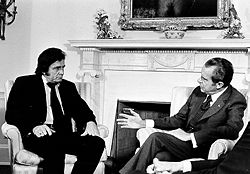
Cash advocated prison reform at his July 1972 meeting with U.S. president Richard Nixon.
From 1969 to 1971, Cash starred in his own idiot box show on the American Dissemination Company network. The singing group The Statler Brothers got their commencement on the testify, opening up for him in every episode. Notable rock artists also appeared on his prove, including Neil Young, The Monkees, and Bob Dylan. Cash had been an early supporter of Dylan, even before they had met, but they became friends while they were neighbors in the late 1960s in Woodstock, New York. Cash was enthusiastic about reintroducing the reclusive Dylan to his audition. Dylan had taken an extended hiatus from performing following a near fatal motorcycle accident on Zena Wood Road near Woodstock in 1968. Greenbacks coaxed Dylan back into the recording studio and sang a duet with Dylan on Dylan'southward land anthology Nashville Skyline, and too wrote the album'southward Grammy-winning liner notes. Some other artist who received a major career heave from The Johnny Cash Show was songwriter Kris Kristofferson. During a alive television performance of Kristofferson's "Sunday Mornin' Comin' Down," Cash fabricated headlines when he refused to change the lyrics to conform network executives, singing the song with its controversial references to marijuana intact: "On the Sunday morning time sidewalks / Wishin', Lord, that I was stoned."
Immensely pop, and an imposingly tall figure, by the early 1970s he had crystallized his public image as "The Man in Black." He regularly performed dressed all in black, wearing a long, black, knee-length coat. This outfit stood in stark dissimilarity to the costumes worn by most of the major country acts in his day: rhinestone Nudie suits and cowboy boots. In 1971, Cash wrote the vocal "Human being in Blackness" to assistance explain his dress code:
I wear the black for the poor and the beaten downwards, / Livin' in the hopeless, hungry side of boondocks, / I wear information technology for the prisoner who has long paid for his crime, / But is there because he'southward a victim of the times.
He and his band had initially worn blackness shirts because that was the but matching color they had among their various outfits (Cash 1997). He wore other colors onstage early in his career, simply he claimed to like wearing black both on- and offstage.
In the mid-1970s, Greenbacks'south popularity and striking songs began to decline, but his autobiography (the offset of ii) titled, Man in Black, was published in 1975 and sold 1.3 million copies. (A second, Cash: The Autobiography, appeared in 1997.) His friendship with Baton Graham led to the product of a picture show nearly the life of Jesus of Nazareth, The Gospel Road, which Cash co-wrote and narrated. The decade saw his religious conviction deepening and he made many public appearances in an evangelical capacity.
He also continued to appear on tv, hosting an annual Christmas special on the Columbia Broadcasting System throughout the 1970s. Afterwards television appearances included a office in an episode of the detective serial Columbo. He likewise appeared with his wife on an episode of Little House on the Prairie, entitled "The Collection" and gave a stirring performance equally John Dark-brown in the 1985 American Civil State of war television receiver mini-series North and South.
He was friendly with every U.S. president beginning with Richard Nixon. He had little association with Neb Clinton and George West. Bush considering of a personal distrust of both men and because of his declining health. He was closest with Jimmy Carter, who was really a very close friend, but not related to his wife, June Carter Cash. None of these friendships were about politics, every bit he never particularly supported any administration, but was just friendly with the nation'southward leaders. He stated that he found all of them personally charming, noting that that fact was probably essential to getting oneself elected (Cash 1997).
Highwaymen
In 1980, Greenbacks became the Country Music Hall of Fame's youngest living inductee at age 48, simply during the 1980s, his records failed to brand a major bear upon on the country charts, though he connected to tour successfully. In the mid-1980s, he recorded and toured with Waylon Jennings, Willie Nelson, and Kris Kristofferson as The Highwaymen, making two hitting albums.
During this catamenia, Cash appeared as an actor in a number of goggle box films. In 1981, he starred in The Pride of Jesse Hallam. Greenbacks won fine reviews for his work in this pic that chosen attending to adult illiteracy. In 1983, Cash also appeared as a heroic sheriff in Murder in Coweta County, which co-starred Andy Griffith as his nemesis. This film was based on a real life Georgia murder case; Greenbacks had tried for years to make the film, which would win him acclamation. (Coincidentally, in 1974, Cash starred equally a country singer killer in the Columbo movie, Swan Vocal.) Greenbacks and his wife appeared on a number of episodes of the popular television series Dr. Quinn, Medicine Woman, starring Jane Seymour. The extra idea so highly of Cash that she later named one of her twin sons after him.
Cash relapsed into habit later on a serious tummy injury in 1983, caused past a baroque incident in which he was kicked and critically wounded past an ostrich he kept on his farm. He was administered painkillers every bit function of the recovery procedure, which led to the relapse (Keast 2001). During his recovery at the Betty Ford Clinic in 1986, he met and befriended Ozzy Osbourne (Cash 1997).
At some other infirmary visit in 1988, this time to spotter over Waylon Jennings (who was recovering from a center attack), Jennings suggested that Cash have himself checked into the hospital for his ain eye condition. Doctors recommended preventive heart surgery, and Cash underwent double bypass surgery in the same hospital. Both recovered, although Cash refused to use whatever prescription painkillers, fearing a relapse into dependency. Greenbacks later claimed that during his operation, he had what is chosen a "virtually-decease experience." He said he had visions of heaven that were so beautiful that he was aroused when he woke upwards live.
American Recordings
His career was rejuvenated in the 1990s, leading to unexpected popularity and iconic status among a younger audience non traditionally interested in country music, such every bit aficionados of culling rock and hip hop music. In 1993, he sang the vocal on U2's "The Wanderer" for their anthology Zooropa*. Although he was no longer sought after past major labels, Cash was approached by producer Rick Rubin* and offered a contract with Rubin's American Recordings characterization, meliorate known for rap music and hard rock than for country music. Under Rubin's supervision, he recorded the album American Recordings (1994) in his living room, accompanied merely by his guitar. The anthology featured several covers of contemporary artists, and saw much critical and commercial success. Greenbacks wrote that his reception at the 1994 Glastonbury Festival was i of the highlights of his career. This was the first of a decade of music industry accolades and surprising commercial success. In 1996, Cash released a sequel, Unchained, and enlisted the accompaniment of Tom Petty and the Heartbreakers, which won a Grammy for Best State Album.
Sickness and expiry
In 1997, Cash was diagnosed with the neurodegenerative disease Shy-Drager syndrome, a diagnosis that was later contradistinct to autonomic neuropathy associated with diabetes. The illness forced Cash to curtail his touring. He was hospitalized in 1998, with severe pneumonia, which damaged his lungs. The albums American III: Alone Man (2000) and American 4: The Homo Comes Around (2002) contained Greenbacks's response to his illness in the form of songs of a slightly more somber tone than the first 2 American albums. The video for "Injure," a cover of the Ix Inch Nails vocal, and generally recognized every bit his epitaph, from American Four received particular critical and popular acclaim.
His married woman June Carter Cash died of complications following middle valve replacement surgery on May 15, 2003, at the age of 73. June had told Cash to continue working, so he continued to record, and even performed a couple of surprise shows at the Carter Family unit Fold outside Bristol, Virginia. His final public advent was on July v, 2003. At a June 21, 2003, concert, before singing "Band of Burn," Cash read a statement shortly before taking the stage most his late wife. He spoke of how June's spirit was watching over him and how she had come to visit him earlier going on phase. He barely made it through the song. Despite his health issues, he talked of looking forwards to the day when he could walk again and toss his wheelchair into the lake nearly his home.
Less than 4 months after his wife'southward death, Johnny Cash died at the historic period of 71 due to complications from diabetes, which resulted in respiratory failure, while hospitalized at Baptist Infirmary in Nashville, Tennessee. He was interred next to his wife in Hendersonville Memory Gardens nearly his abode in Hendersonville, Tennessee.
On May 24, 2005, Rosanne Greenbacks'due south birthday, Vivian, his starting time wife and female parent to Rosanne, died from surgery to remove a lung.
In June of 2005, his lakeside home on Caudill Drive in Hendersonville, Tennessee, went upward for sale by the Greenbacks manor. In January 2006, the house was sold to a corporation owned by Bee Gees' vocaliser Barry Gibb for $2.5 million. The listing agent was Cash'due south younger brother Tommy.
One of Johnny Greenbacks'southward final collaborations with producer Rick Rubin, entitled American Five: A Hundred Highways, was released posthumously on July iv, 2006. The album debuted in the number 1 position on Billboard Magazine's Height 200 album chart the week ending July 22, 2006. The vocal parts of the track were recorded before Greenbacks's death, merely the instruments were non recorded until tardily 2005. American VI is expected to exist released in mid-2007.
Legacy
From his early on days as a pioneer of rockabilly and rock and roll in the 1950s, to his decades every bit an international representative of state music, his resurgence to fame as both a living legend and an alternative country music icon in the 1990s, Cash has influenced countless artists and left a trunk of work matched but past the greatest artists of his time. Upon his death, Cash was revered by many of the greatest popular musicians of his fourth dimension.
Greenbacks nurtured and defended artists on the fringes of what was acceptable in country music, even while serving as the country music establishment's most visible symbol. At an all-star concert in 1999, a diverse group of artists paid him tribute, including Bob Dylan, Chris Isaak, Wyclef Jean, Norah Jones, Kris Kristofferson, Willie Nelson, and U2. Two tribute albums were released shortly before his death; Kindred Spirits contains works from established artists, while Dressed In Blackness contains works from many lesser-known artists.
In total, he wrote over a 1000 songs and released dozens of albums, a box set, titled Unearthed, was issued posthumously. Information technology included four CDs of unreleased material recorded with Rubin, as well every bit a All-time of Cash on American retrospective CD.
In recognition of his lifelong support of SOS Children's Villages, his family invited friends and fans to donate to that charity in his memory. He had a personal link with the SOS hamlet in Diessen, at the Ammersee-Lake in southern Germany, near where he was stationed equally an American GI, and also with the SOS hamlet in Barrett Town, by Montego Bay, almost his holiday home in Jamaica. Thus, the Johnny Cash Memorial Fund was founded to aid the above causes.
Lists of accomplishments
Cash received multiple State Music Awards, Grammy Awards, and other awards, in categories ranging from vocal and spoken performances to album notes and videos.
In a career that spanned nigh five decades, Cash was the personification of land music to many people effectually the world, despite his distaste for the Nashville mainstream. Cash was a musician who was not tied to a unmarried genre. He recorded songs that could be considered rock and roll, blues, rockabilly, folk music and gospel music, and exerted an influence on each of those genres. Moreover, he had the unique distinction amongst country artists of having "crossed over" late in his career to go pop with an unexpected demographic, indie and alternative rock fans. His diverseness was evidenced by his presence in iii major music halls of fame: the Nashville Songwriters Hall of Fame (1977), the Country Music Hall of Fame (1980), and the Rock and Scroll Hall of Fame (1992). Only 10 performers are in both of the concluding two, and only Hank Williams Sr. and Jimmie Rodgers share the honour with Cash of being in all iii. His pioneering contribution to the genre has too been recognized by the Rockabilly Hall of Fame as Inductee #115. [i] He received the Kennedy Eye Honors in 1996.
Greenbacks stated that his consecration into the Country Music Hall of Fame in 1980 was his greatest professional accomplishment (Cash 1997).
Samples
- "I Walk the Line" – Download Sample
- "Hurt" – Music Video at YouTube (accessed Feb fourteen, 2007)
Selected Bibliography
- Cash, Johnny. 1975. Man in Black: His Own Story in His Own Words. Grand Rapids, MI: Zondervan. ISBN 999243158X
- Cash, Johnny. 1997. Cash: The Autobiography. With Patrick Carr. New York: Harper Collins. ISBN 0061013579
- Greenbacks, Johnny. 2000. Beloved. Liner notes written with June Carter Greenbacks. New York: Sony.
References
ISBN links support NWE through referral fees
- Gross, Terry. 2006. All I Did Was Ask: Conversations with Writers, Actors, Musicians, and Artists. Hyperion. ISBN 1401300103
- "Johnny Cash Expressionless At 71." MTV.
- Keast, James. 2001. Johnny Cash: The Insubordinate. Retrieved September 7, 2004.
- Miller, Nib. JohnnyCash.com. Retrieved September 7, 2004.
- Peneny, D. 1000. Johnny Greenbacks. The History of Rock and Roll. Retrieved September vii, 2004.
- Streissguth, Michael. 2004. Johnny Cash at Folsom Prison: The Making of a Masterpiece. Da Capo Press. ISBN 0306813386.
- Urbanski, Dave. 2003. The Man Comes Around: The Spiritual Journeying of Johnny Cash. New York: Relevant Books. ISBN 0972927670.
External links
All links retrieved May 24, 2018.
- Official Website of Johnny Cash
- Johnny Cash at the Country Music Hall of Fame
- Johnny Cash at the Rock and Curlicue Hall of Fame
- Johnny Cash at the Rockabilly Hall of Fame
- Operation at the Carter Family Fold – YouTube
Credits
New World Encyclopedia writers and editors rewrote and completed the Wikipedia commodity in accord with New Earth Encyclopedia standards. This commodity abides by terms of the Artistic Commons CC-by-sa 3.0 License (CC-by-sa), which may be used and disseminated with proper attribution. Credit is due under the terms of this license that can reference both the New World Encyclopedia contributors and the selfless volunteer contributors of the Wikimedia Foundation. To cite this article click hither for a list of adequate citing formats.The history of earlier contributions past wikipedians is attainable to researchers here:
- Johnny Greenbacks history
The history of this article since information technology was imported to New World Encyclopedia:
- History of "Johnny Cash"
Note: Some restrictions may employ to employ of individual images which are separately licensed.
Source: https://www.newworldencyclopedia.org/entry/Johnny_Cash
0 Response to "Johnny Cash Back in the High Life Again"
Post a Comment